 Quote Request
Compare Multiple Quotes On Your Made To Match Wooden Products


Skirting Board - To Match.
Skirting boards made to match, in solid timber, made to order. Every skirting board on WoodUChoose is cut to order from solid wood, so the profile does not have to come off a retailer's shelf. If you can show a UK timber supplier the moulding you are matching, they can run it again: same section, same height, same wood.
This is the service most people find when they are restoring a period property. We regularly help people match Victorian skirting boards, Edwardian, Georgian, Regency, Arts and Crafts and 1930s Art Deco profiles for listed buildings, conservation areas, and houses where one room has been lost to an extension or a damp repair. It works just as well in a new build where you want a deeper, more traditional skirting than the standard ranges allow.
Any profile. Classic patterns such as ogee, torus, bullnose, ovolo, lambs tongue, chamfered, square edge, pencil round and scotia are routine work, and a one-off house pattern that exists only in your hallway is no harder: it is a cutter and a run of timber.
Any wood. Solid oak, pine, ash, beech, cherry, sapele, black walnut and Douglas fir, whether you intend to stain and wax it or paint it. Pick the skirting board profile closest to yours below, choose your timber and give your sizes, and we put a single enquiry in front of our network of UK timber suppliers so the quotes come back to you.


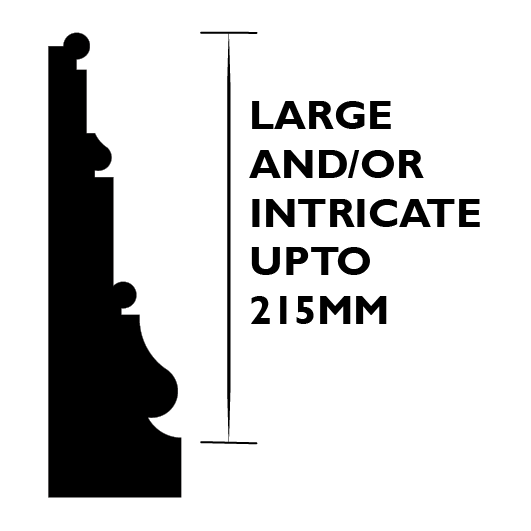
Skirting Board - To Match - Further Reading:
Bringing period detail back to life with our made to match skirting board service
Restoration work rarely goes wrong on the wood. It goes wrong on the profile. A modern off-the-shelf board next to an original Victorian one reads as wrong from the doorway even when the paint matches, because the height, the thickness and the curve of the moulding are all slightly out. Matching the original is what keeps a period room honest, and on a listed building or in a conservation area it is usually what the conservation officer expects to see. We match the timber species, the profile of the moulding, the finish and the proportions of the original as closely as they can be reproduced.
How to match an existing skirting board
Three things let a supplier quote you accurately.
- The height. Measure in millimetres from the finished floor to the top of the board, on a wall where the floor has not been rebuilt.
- The thickness. Measure from the wall face to the front of the board at its thickest point. On an original this is commonly 18mm to 25mm, deeper than most modern stock.
- The profile. This is the shaped section along the top edge, and it is the part a description will never capture. The reliable way to record it is a short offcut, 100mm or so, taken from behind a radiator or inside a cupboard where the loss will never show. If you cannot cut one, stand card against the end of a board, trace the outline in pencil and photograph the tracing next to a tape measure. A straight-on photograph of the cut end of a board works too.
Keep the sample, the tracing or the photograph to hand when you enquire. A supplier can grind a cutter from a traced section; nobody can work from words alone.
Torus or ogee? Telling the common profiles apart
Two profiles cover most British housing, and they are the two people most often mix up.
- Torus is a convex half-round bead: one continuous outward bulge, usually sitting above a small step. It reads as soft and rounded.
- Ogee is an S curve, concave running into convex, so the top rolls back towards the wall. It reads as sharper and more formal.
- Ovolo is a quarter round. Lambs tongue is a shallower S with a flat run-out. Bullnose is a plain rounded top edge, and chamfered is a flat angled cut with no curve at all. Square edge and pencil round are the plainest of the modern patterns.
If yours matches none of them, it is almost certainly a house pattern cut by the original joiner. That is completely normal in Victorian and Georgian work, and it is exactly what a made to match service is for.
What height should the skirting board be?
Modern stock skirting is typically 120mm to 145mm. Original Victorian and Regency boards in a principal room are often far deeper, commonly 175mm to 300mm, because the ceilings were higher and the board was doing real visual work. Edwardian and 1930s boards usually sit between the two. If you are matching one room to the rest of the house, copy the house rather than the catalogue. Where a new floor has raised the level, quote the height you now need rather than the height you measured off the old board.
How the quotes work
WoodUChoose does not hold stock and does not sell timber. We connect you with UK timber suppliers who cut to order, so one enquiry reaches several of them.
- Choose the skirting board profile closest to yours from the types shown on this page.
- Choose your timber, or ask for a recommendation if you are not sure whether to paint it or finish it clear.
- Enter your sizes and the total running length you need, with a sensible allowance for mitres and waste.
- You see indicative pricing straight away, then request full quotes from the supplier network.
You can start from the made to match wizard, or pick one of the skirting board types on this page and enquire from there. If you are matching skirting and architrave in the same room, say so in the enquiry: it is normally cheaper to have both run from the same timber in the same batch.
Return to Skirting Board - To Match Introduction and Products »